
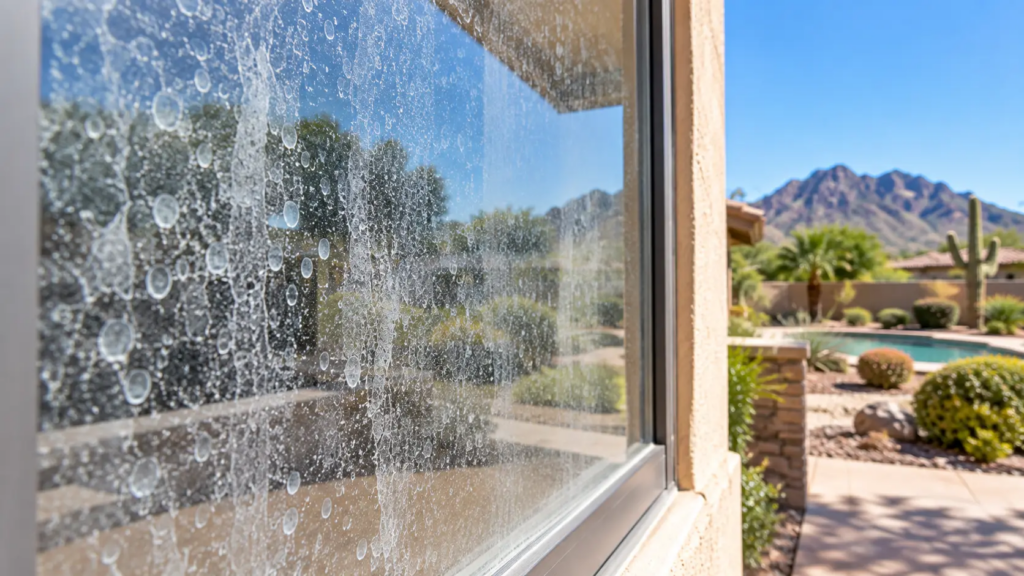
Those small white spots on your windows may seem like nothing more than a cleaning problem. But when mineral deposits remain on glass for long periods, homeowners often begin asking a more serious question: can hard water permanently damage or etch window glass?
For homeowners in Phoenix and other parts of Arizona, this question is especially relevant. Exterior windows can be repeatedly exposed to sprinkler overspray, irrigation water, intense sunlight, dust, and other environmental conditions.
When water evaporates from glass, dissolved minerals can remain behind. Repeated exposure can create increasingly stubborn deposits that may become much harder to remove than ordinary dirt.
Understanding the difference between removable mineral buildup and potential glass damage can help Arizona homeowners take action before a minor cosmetic problem becomes more difficult to address.
What Are Hard Water Spots on Windows?
Hard water contains dissolved minerals. When droplets of this water reach your windows and evaporate, some of those minerals can remain on the surface.
At first, you may notice small circular white spots.
These can appear on windows exposed to:
- Lawn sprinklers
- Irrigation systems
- Garden hoses
- Outdoor water features
- Repeated water runoff
If the exposure happens regularly, new mineral residue can accumulate over existing deposits.
This is why a window that initially had a few barely noticeable spots may eventually develop a cloudy or stained appearance.
Can Hard Water Etch Glass?
This is where the distinction between surface deposits and actual glass damage becomes important.
Mineral deposits can sometimes remain primarily on the surface and respond to an appropriate cleaning or restoration process.
However, prolonged contamination and chemical interactions at the glass surface can make staining increasingly difficult to correct. In severe cases, what appears to be a simple hard water stain may no longer behave like ordinary surface residue.
Homeowners often describe this condition as “etched glass.”
The practical takeaway is simple: don’t assume that every mineral stain will remain easy to remove indefinitely.
Early attention is generally preferable to allowing deposits to repeatedly build up.
How Can You Tell if Hard Water Is Affecting Your Windows?
Start by looking at the pattern.
Hard water spots often appear as circular marks, cloudy patches, or whitish residue.
Now consider where they’re located.
If the affected window is directly beside landscaping and a sprinkler sprays toward it several times a week, irrigation water is an obvious factor worth investigating.
You can also compare windows around your property.
If windows near sprinklers have heavy spotting while protected windows remain relatively clear, that difference can provide an important clue.
Why Are Phoenix Homes Vulnerable to Sprinkler Water Spots?
Phoenix homeowners frequently use irrigation systems to maintain lawns and landscaping in a dry climate.
That’s perfectly normal.
The problem begins when irrigation water regularly reaches surfaces it wasn’t intended to water.
A sprinkler head that is slightly misaligned can spray a nearby window every time the system runs.
The Arizona sun then helps the water evaporate quickly.
The moisture disappears, but mineral residue can remain.
Repeat that process week after week and the window can develop increasingly visible spotting.
Does Arizona Sunlight Make the Problem Worse?
Sunlight doesn’t create the minerals in the water, but Arizona’s hot and dry conditions can encourage rapid evaporation.
That’s important because evaporation is what leaves dissolved material behind on the surface.
The combination of irrigation, evaporation, dust, and repeated exposure can make exterior windows challenging to maintain.
Bright sunlight can also make spots particularly noticeable.
A window may appear relatively clean from one angle but suddenly reveal extensive spotting when sunlight reflects across it.
Can Regular Window Cleaner Remove Hard Water Spots?
Sometimes normal cleaning removes light contamination. But ordinary household window cleaner isn’t designed to solve every mineral-deposit problem.
If you’ve cleaned the glass properly and the circular white marks remain, continuing to spray more general-purpose cleaner may accomplish very little.
This is one reason it’s useful to determine whether you’re dealing with:
- Ordinary dirt
- Cleaning residue
- Mineral deposits
- A damaged or deteriorated surface
- Cloudiness between insulated glass panes
These aren’t all the same problem and shouldn’t automatically receive the same treatment.
Be Careful With DIY Hard Water Removal
Search online and you’ll find countless suggestions for removing stubborn deposits.
Some approaches are relatively mild. Others recommend aggressive abrasives, scraping, harsh chemicals, or combinations of products.
Be cautious.
Different windows can have different coatings, films, treatments, and manufacturing characteristics. A technique that appears to work on one piece of glass may not be appropriate for another.
Aggressive scrubbing can also introduce scratches.
Before using an abrasive product or blade, make sure the method is appropriate for the specific surface you’re cleaning.
When the glass is expensive, difficult to replace, or heavily stained, professional assessment may be the safer option.
How Can You Prevent Hard Water Damage?
Prevention starts with controlling the source.
Run your irrigation system during daylight hours and observe where the water actually goes.
If sprinkler mist is reaching your windows, adjust the sprinkler heads so they’re directed toward the landscaping rather than the house.
Also check for damaged or tilted heads.
A sprinkler system that was properly adjusted months ago can change due to landscaping work, accidental impact, soil movement, or equipment wear.
Next, don’t allow visible mineral buildup to accumulate indefinitely.
Regular window maintenance makes it easier to notice and address recurring problems.
Professional Window Cleaning in Phoenix
Professional window cleaning is particularly useful when mineral spots no longer respond to ordinary cleaning or when the affected glass is difficult to safely access.
CDI Professional Services provides window cleaning for residential and commercial properties in Phoenix and surrounding Arizona communities.
Professional cleaning can address more than just visible fingerprints and dust. Windows exposed to irrigation, mineral deposits, desert conditions, and environmental debris may benefit from a more complete cleaning approach.
Frames, screens, and tracks can also accumulate significant amounts of Arizona dust and dirt.
When Should You Call a Professional?
Consider professional help when:
- Hard water spots keep returning
- Ordinary cleaning doesn’t remove the marks
- Large sections of glass appear cloudy
- Mineral deposits have been present for a long time
- Multiple windows are affected
- Second-story windows are involved
- You’re considering aggressive scraping or abrasive products
- You’re unsure whether the glass is stained or actually damaged
The longer a stubborn condition remains untreated, the less sense it makes to keep experimenting with random household solutions.
Frequently Asked Questions
Can hard water permanently damage windows?
Persistent mineral contamination can become increasingly difficult to correct and may affect the glass surface over time. Address recurring deposits early rather than allowing them to accumulate indefinitely.
What does hard water damage look like on glass?
It can appear as white circular spots, cloudy areas, chalky residue, or stains that remain visible after ordinary window cleaning.
Why do my windows have white spots near the bottom?
Check nearby sprinklers and irrigation systems. The spotting pattern may correspond with where sprinkler water repeatedly reaches the glass.
Can professional window cleaning remove hard water stains?
The result depends on the severity and condition of the glass. Surface mineral deposits may respond to appropriate professional cleaning, while severe or long-standing damage can require additional assessment.
How do I prevent hard water spots on my Arizona windows?
Keep sprinklers directed away from windows, periodically inspect irrigation equipment, and don’t allow mineral deposits to accumulate for long periods.
Protect Your Windows From Recurring Mineral Buildup
Hard water spots are much easier to ignore when they’re small.
But if your Phoenix windows are repeatedly exposed to sprinkler water, those spots can continue accumulating until the glass looks cloudy even after normal cleaning.
The smarter approach is prevention.
Control sprinkler overspray, maintain your windows regularly, and address persistent mineral buildup before it becomes increasingly difficult to correct.
If you’re dealing with stubborn water spots or cloudy exterior glass, contact CDI Professional Services to learn more about professional window cleaning in Phoenix and surrounding Arizona communities.