
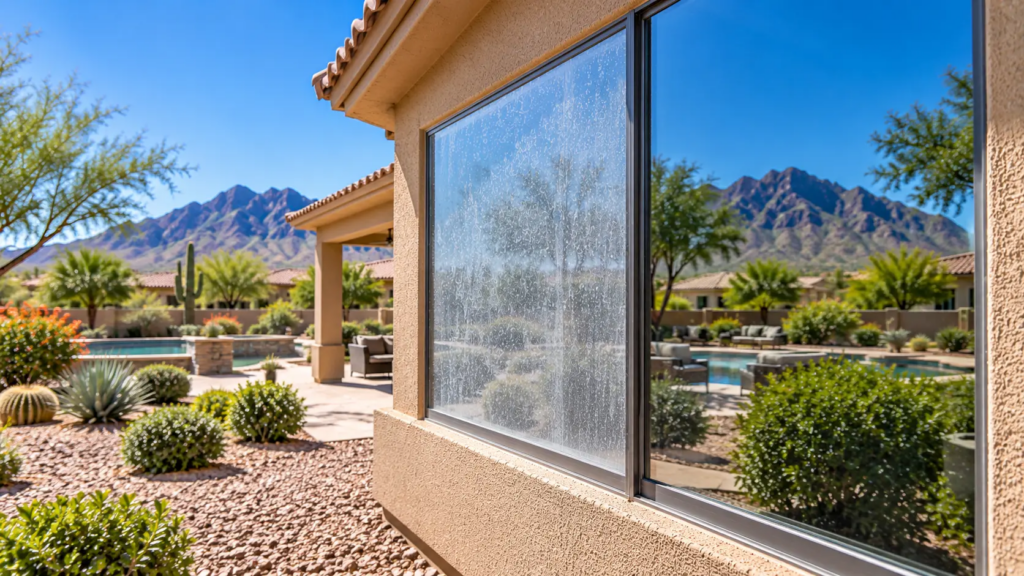
You clean your windows, wipe away the dirt, and expect crystal-clear glass. Instead, the windows still look cloudy, hazy, or covered with a dull film.
If you’ve ever wondered, “Why are my windows still cloudy after cleaning?”, the problem may not be your cleaning technique.
For homeowners in Phoenix and throughout Arizona, cloudy windows can have several possible causes. Desert dust, mineral deposits, sprinkler water, cleaning residue, dirty screens, and even problems between insulated glass panes can all affect how clear a window looks.
Before cleaning the same window over and over again, it helps to identify what is actually causing the haze.
Here are seven possibilities.
1. Hard Water and Mineral Deposits
One of the first things to investigate is mineral buildup.
When water reaches exterior glass and evaporates, dissolved minerals can remain on the surface. Over time, repeated exposure can create white spots, cloudy patches, or a dull film.
Sprinklers are a common source.
If landscaping irrigation regularly sprays your windows, each cycle can potentially leave additional residue behind.
This can explain why ordinary window cleaner removes the dirt but doesn’t eliminate the cloudy appearance.
Look closely at the glass in bright sunlight. Mineral deposits may appear as circular white marks, irregular cloudy areas, or residue concentrated where sprinkler water regularly hits the window.
2. Your Sprinklers Are Repeatedly Hitting the Glass
Sometimes the problem isn’t how you’re cleaning the windows.
It’s what happens afterward.
Imagine cleaning a window perfectly on Saturday morning. Later that evening, your irrigation system runs and a nearby sprinkler sprays the glass.
The water dries, leaving spots behind.
Within a few irrigation cycles, the window can look dirty again.
This can be especially frustrating for homeowners in Phoenix because irrigation systems are frequently used to maintain landscaping in Arizona’s dry environment.
Turn on your sprinklers and watch them operate.
If water or mist is reaching your windows, adjust the sprinkler heads so they’re directed toward the landscaping rather than the house.
3. Cleaning Product Residue Is Left Behind
More cleaning solution doesn’t necessarily mean cleaner windows.
Using too much product or failing to properly remove residue can leave a film on the glass.
The window may technically be cleaner than before, but the remaining product can create streaks or haze that become very noticeable in direct sunlight.
This is one reason professional window cleaning focuses not only on loosening dirt but also on leaving the glass properly finished.
If your windows look clear in the shade but suddenly reveal streaks when sunlight hits them, cleaning residue may be contributing to the problem.
4. Arizona Dust Is Still on the Screens and Frames
Phoenix-area properties are constantly exposed to dust.
Even when the glass itself is cleaned, window screens, frames, sills, and tracks can continue holding dirt.
A dusty screen can also affect the way the window looks from inside the home.
Take a close look at the entire window rather than focusing exclusively on the glass.
You may discover that much of what looks like a dirty or cloudy window is actually contamination on the screen.
This is one reason a more complete window-cleaning service can make such a noticeable visual difference.
5. Mineral Deposits Have Become Difficult to Remove
There’s a major difference between ordinary dirt and long-standing mineral contamination.
Dirt may wash away relatively easily.
Mineral deposits that have repeatedly accumulated on glass can be considerably more stubborn.
If your windows have been exposed to sprinkler water for months or years, normal household window cleaner may no longer be enough to produce the result you expect.
Avoid immediately reaching for abrasive pads, blades, or harsh chemicals.
Improper cleaning methods can potentially scratch glass or damage certain window surfaces.
When deposits don’t respond to routine cleaning, professional assessment is often a better next step than increasingly aggressive DIY experimentation.
6. The Cloudiness May Be Between the Glass Panes
This is an important distinction.
If you have double-pane or insulated windows, the haze may not actually be on the exterior or interior surface you can touch.
Sometimes moisture or cloudiness appears between the panes.
Try cleaning both accessible sides of the window.
If the hazy appearance remains and seems trapped inside the window assembly, ordinary window cleaning may not solve the problem.
That can indicate an issue involving the insulated glass unit or its seal rather than surface contamination.
Professional window cleaners can clean accessible surfaces, but a problem occurring inside a sealed window assembly may require evaluation by a window repair or replacement professional.
7. You’re Seeing a Combination of Problems
Not every cloudy window has a single cause.
A Phoenix exterior window might simultaneously have:
- Desert dust
- Sprinkler spots
- Mineral residue
- Dirty screens
- Dusty frames
- Cleaning streaks
That combination can make the glass appear much worse than any one problem alone.
This is also why repeatedly spraying household cleaner on the center of the glass may produce disappointing results.
Sometimes the entire window area needs attention.
How Can You Tell What’s Making Your Windows Cloudy?
Start with a visual inspection.
Look at the window from both inside and outside.
Next, clean a small test section using an appropriate non-abrasive window-cleaning method.
If the haze disappears, you were probably dealing primarily with surface dirt or residue.
If white circular spots remain, mineral deposits may be involved.
If the cloudiness appears to be trapped between two panes, the issue may involve the insulated glass unit.
Also compare different windows around the property.
For example, if windows near sprinklers are cloudy while protected windows remain clear, irrigation exposure becomes a strong clue.
Why Phoenix Windows Can Be Difficult to Keep Clean
Arizona’s desert environment creates a unique combination of conditions for exterior windows.
Dust can accumulate during long dry periods. Wind can move fine particles across properties. Landscaping irrigation can introduce water onto dusty glass, while strong sunlight makes streaks, spots, and residue extremely visible.
This means window cleaning in Phoenix often involves more than removing fingerprints.
Homeowners need to consider what is happening outside the property as well.
How Often Should Phoenix Homeowners Clean Their Windows?
There isn’t one schedule that works for every property.
A home located near a busy road may accumulate dirt faster than one in a protected residential area.
Properties with extensive landscaping and irrigation may experience more water spotting.
Homes exposed to construction activity, windblown dust, or frequent outdoor entertaining may also benefit from more frequent cleaning.
Instead of following an arbitrary calendar, monitor how quickly your windows accumulate visible contamination.
Professional Window Cleaning in Phoenix, Arizona
If your windows remain cloudy after you’ve already cleaned them, continuing to repeat the exact same process probably isn’t the best solution.
The next step is determining why the haze remains.
CDI Professional Services provides professional window cleaning for residential and commercial properties throughout Phoenix and surrounding Arizona communities.
Professional window cleaning can address the glass as well as other components that influence the overall appearance of your windows, including screens, frames, and tracks when applicable.
For difficult-to-reach windows, professional service also eliminates the need for homeowners to take unnecessary risks with ladders or awkward exterior access.
Frequently Asked Questions
Why are my windows cloudy even after I clean them?
Possible causes include cleaning residue, hard water deposits, sprinkler spots, dirty screens, accumulated dust, or cloudiness located between insulated glass panes.
How can I tell if cloudy windows have hard water stains?
Look for white circular spots or mineral-looking residue, particularly on exterior windows near sprinklers or irrigation systems.
Why do my windows look streaky in sunlight?
Direct sunlight can make cleaning residue, mineral deposits, fine dust, and streaks much easier to see.
Can professional window cleaning fix cloudy glass?
It depends on the cause. Surface dirt and certain deposits may respond to professional cleaning. Cloudiness trapped between panes or permanent glass damage may require a different solution.
Why do my windows get dirty so quickly in Arizona?
Dust, wind, irrigation, landscaping, nearby traffic, construction activity, and other environmental conditions can all contribute to exterior window contamination.
Can a broken window seal make glass look cloudy?
Problems with an insulated glass unit can cause moisture or haze to appear between panes. If the cloudiness isn’t on an accessible surface, window cleaning alone may not correct it.
Stop Cleaning the Same Cloudy Window Over and Over
When a window remains hazy after cleaning, the solution isn’t necessarily more cleaning product.
First determine what’s causing the problem.
For Phoenix homeowners, mineral deposits, sprinkler overspray, desert dust, dirty screens, and cleaning residue are all worth investigating. If the haze is trapped between panes, you may be dealing with a window issue rather than a cleaning issue.
And if ordinary cleaning no longer produces clear glass, it may be time for professional help.
Contact CDI Professional Services to learn more about professional window cleaning for homes and businesses in Phoenix and surrounding Arizona communities.